Planes, Trains and Automobiles
Oct 07, 2026Planes, Trains and Automobiles is my all-time favorite movie. I once owned a VHS copy I played so many times it became unviewable. During my extremely short-lived attempt at modeling, (I was much younger then) I was required to deliver a monologue to a small group.
I chose Neal’s rant in the motel room, because, why not. It’s a genius bit of writing and acting by both actors. I’m not ashamed to admit, I cry every time I watch it.
~~~~~~
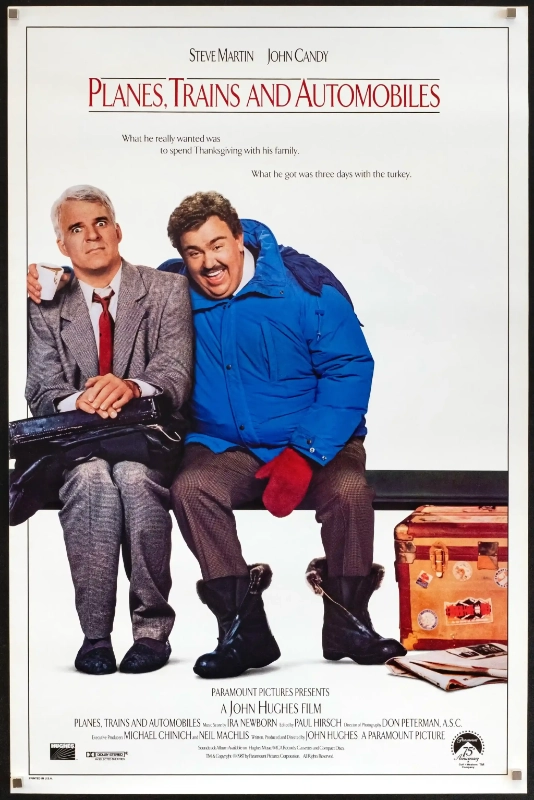
Some comedies are built around jokes. Others are built around characters who happen to be funny.
John Hughes’s Planes, Trains and Automobiles belongs firmly in the second category.
Released on November 25, 1987, the film stars Steve Martin and John Candy as two wildly incompatible strangers attempting to reach Chicago in time for Thanksgiving. What begins as a familiar “odd couple” road comedy gradually becomes something much more affecting: a story about loneliness, impatience, dignity, friendship, and the uncomfortable realization that the person irritating you may be carrying around a pain you never bothered to notice. IMDb
Nearly four decades later, its cars, clothes, pay phones, motel rooms and travel arrangements unmistakably belong to the 1980s. Its emotional machinery, however, has barely aged at all.
A Brief Synopsis
Neal Page, played by Steve Martin, is a successful Chicago advertising executive trying to get home from New York for Thanksgiving. Neal is orderly, impatient and accustomed to a world in which money, schedules and professional competence generally make problems disappear.
Then he meets Del Griffith.
Played by John Candy, Del is a traveling shower-curtain-ring salesman who is talkative, messy, relentlessly friendly and apparently incapable of recognizing when another human being would prefer silence.
A flight cancellation throws the two men together, and what should be a relatively simple trip from New York to Chicago becomes an increasingly absurd odyssey involving airplanes, trains, buses, motel rooms, rental cars, trucks and a succession of travel disasters. The film ultimately earns its wonderfully literal title. IMDb
Neal initially regards Del as an obstacle standing between him and home. Del, meanwhile, keeps attaching himself to Neal with the enthusiasm of a man who has either found a new friend or simply refuses to admit that he hasn't.
That difference is the key to the movie.
Because Planes, Trains and Automobiles eventually reveals that the question isn't simply whether Neal will get home.
It is whether, during the journey, he will actually learn to see the person traveling beside him.
Why the Movie Works
Neal and Del Are More Than an Odd Couple
The obvious comic mechanism is contrast.
Neal is restrained. Del is expansive.
Neal values privacy. Del treats privacy as an unfortunate misunderstanding.
Neal dresses neatly, wants schedules followed and expects competent service. Del carries an enormous trunk, sells shower-curtain rings and appears capable of turning even a simple transaction into a small public event.
Steve Martin's Neal therefore becomes the perfect comic pressure cooker. Martin spends much of the movie trying not to explode.
John Candy's Del gives him endless reasons to do exactly that.
But Hughes makes an important decision: neither man is allowed to remain merely a caricature.
Neal's irritation is frequently justified. Del really is exhausting. He talks too much. He intrudes. He makes mistakes. He can be careless with Neal's possessions and money.
At the same time, Neal's legitimate frustration gradually exposes something less flattering about him: his belief that his own discomfort matters more than Del's humanity.
And Del's cheerfulness, which initially looks like comic obliviousness, eventually begins to resemble something else.
Armor.
That is where the film becomes more interesting than its premise suggests.
The Motel Scene Changes Everything
One of the film's most important scenes contains almost no physical comedy.
After Neal finally unloads his frustration on Del, criticizing his stories, habits and personality, Del doesn't respond with another joke. He admits that he knows people find him irritating.
But he also refuses to accept Neal's judgment as the final word on his worth.
It is the first moment in which we understand that Del's friendliness is not ignorance. He knows perfectly well that people dismiss him.
He simply continues reaching toward them anyway.
Candy's performance makes the scene painful because Del is wounded without becoming pathetic. Hughes allows him something comedies often deny their comic sidekicks: dignity.
From that point forward, the audience knows something Neal doesn't quite understand yet.
There is much more happening inside Del Griffith than Neal has bothered to notice.
The Brilliant Casting of Steve Martin
Steve Martin was already one of America's most recognizable comedians when Planes, Trains and Automobiles arrived. His earlier screen persona had often emphasized absurdity, intellectual silliness and a kind of brilliantly controlled ridiculousness.
Here, Hughes asks him to do almost the opposite.
Neal Page is funny because he wants desperately to remain reasonable.
Martin becomes a master of suppressed rage: tightened jaws, frozen expressions, long pauses and increasingly desperate attempts to behave like a civilized adult while the universe systematically destroys every civilized option available to him.
The film's most famous eruption occurs at a rental-car counter.
After enduring yet another transportation disaster, Neal unleashes an astonishing profanity-laden complaint at the cheerful clerk played by Edie McClurg. IMDb's production trivia notes that the one-minute exchange contains the F-word 19 times, a scene largely responsible for the film's R rating. McClurg's wonderfully mundane telephone conversation immediately before Neal's tirade was partly improvised at Hughes's direction. IMDb
What makes the scene funny isn't really the profanity.
It's Neal.
The impeccably controlled businessman has finally been reduced to volcanic fury—and the woman behind the counter remains magnificently unimpressed.
Martin reportedly was particularly attracted to the screenplay by that sequence and the later car-seat-adjustment scene. IMDb
But his most important work in the film is quieter.
Watch Neal toward the end of the movie. Martin gradually removes the defensive tension from the character. Neal begins listening instead of reacting.
That transition is what allows the ending to work.
John Candy and the Sadness Inside the Joke
If Martin provides the film's comic tension, John Candy provides its soul.
Candy had an extraordinary ability to make large, boisterous characters feel vulnerable without asking audiences to pity them.
Del Griffith may be one of the finest examples.
Candy plays him as a man who occupies too much space socially and physically, but who is constantly searching for permission to belong there.
He talks.
He jokes.
He sells.
He tells stories.
He makes friends with strangers.
And increasingly we begin to suspect that all of this activity is designed to prevent silence.
Steve Martin would later describe Candy as an exceptionally sweet, outgoing man while also suggesting that he sensed a kind of hidden sadness underneath. That description sounds remarkably appropriate for Del. IMDb
Hughes wisely doesn't announce the character's emotional truth early.
Instead, he leaves clues.
Del rarely talks convincingly about where he is going once the trip ends. His life seems to exist in luggage, hotel rooms and sales territories. He continually gravitates toward Neal's family life even while pretending he has one of his own waiting somewhere else.
Once the truth becomes clear, earlier scenes rearrange themselves in the viewer's memory.
What initially looked like neediness suddenly looks like loneliness.
That retrospective change is one reason the movie rewards repeat viewing.
The Ending—and Why It Earns Its Sentiment
John Hughes had a reputation for sentimentality, sometimes deservedly.
But Planes, Trains and Automobiles earns its ending through restraint.
The revelation about Del does not arrive through an enormous speech explaining his entire past.
Neal simply begins thinking.
He remembers inconsistencies.
He replays remarks.
He recognizes what was sitting directly in front of him.
And then he goes back.
That matters.
Neal does not merely feel sorry for Del. He changes his behavior.
The journey has taught him that getting home means very little if your definition of “home” excludes somebody who has nowhere to go.
When Del is finally brought into Neal's household, the movie transforms Thanksgiving from a destination into an idea: making room at the table.
It is sentimental.
It is also thoroughly earned.
John Hughes: America's Chronicler of the Awkward Moment
John Hughes was born in 1950 and became one of the defining writer-directors of 1980s American popular cinema. Before filmmaking, he worked in advertising and wrote humor, including material associated with National Lampoon.
His extraordinary run during the 1980s included Sixteen Candles, The Breakfast Club, Weird Science, Ferris Bueller's Day Off and Planes, Trains and Automobiles, while his screenwriting credits also extended into films such as Pretty in Pink, Some Kind of Wonderful and later Home Alone.
If Hughes's name is most commonly associated with teenagers, Planes, Trains and Automobiles demonstrates that his real subject was broader.
Hughes was fascinated by people trapped inside social identities.
The popular kid.
The nerd.
The delinquent.
The princess.
The suburban father.
The obnoxious traveling salesman.
His stories repeatedly ask what happens when those identities are disrupted long enough for two people to encounter one another as human beings rather than categories.
That is essentially the structure of The Breakfast Club.
It is also the structure of Planes, Trains and Automobiles.
Only instead of locking five teenagers inside a school library, Hughes strands two middle-aged men somewhere between New York and Chicago.
The film also reveals Hughes's affection for the American Midwest. Chicago and its suburbs recur throughout his work, and although Planes, Trains and Automobiles travels widely, Chicago remains its emotional destination.
Hughes died in 2009 at age 59, leaving behind a filmography whose influence on American comedy and coming-of-age storytelling remains unusually strong.
Steve Martin: From Wild and Crazy to Quietly Human
Born in 1945, Steve Martin developed one of the most unusual careers in American comedy.
He began as a writer, including work for television, before becoming an enormously successful stand-up performer during the 1970s. His deliberately ridiculous stage persona played with the very idea of how a comedian was supposed to behave: white suit, banjo, fake arrogance, arrows through the head and routines that often mocked conventional punch-line comedy.
By the late 1970s and early 1980s, Martin had moved increasingly into film with pictures such as The Jerk, Dead Men Don't Wear Plaid, The Man with Two Brains and All of Me.
What Planes, Trains and Automobiles showed particularly well was his ability to play a relatively normal man.
Neal is not stupid.
He isn't a clown.
He is frequently correct.
And that makes his unraveling much funnier.
Martin continued balancing broad comedy with sophisticated or melancholy material in films including Roxanne, Dirty Rotten Scoundrels, Parenthood, L.A. Story and Father of the Bride. His career has also encompassed writing, theater, music—particularly the banjo—and later television.
His performance as Neal demonstrates an aspect of Martin's comedy that sometimes gets overshadowed by the absurdist material: he is an exceptional reactor.
Put chaos in front of Steve Martin and simply watch his face.
John Candy: Canada's Great Big Heart
John Candy was born in Toronto in 1950 and became one of the most beloved Canadian performers of his generation.
Like several major comic talents of the era, Candy's career was closely connected to Toronto's Second City comedy scene and the television series SCTV, whose cast also included performers such as Eugene Levy, Catherine O'Hara, Joe Flaherty and Andrea Martin.
Hollywood quickly discovered that Candy could perform both enormous comedy and extraordinary warmth.
His film work included Stripes, Splash, Brewster's Millions, Spaceballs, The Great Outdoors, Uncle Buck, Cool Runnings and Only the Lonely.
But Del Griffith arguably remains his signature performance because it uses everything Candy did particularly well.
He could be loud without seeming cruel.
Embarrassing without becoming hateful.
Sad without becoming maudlin.
Candy died unexpectedly in 1994 at only 43.
His relatively short life makes performances such as Del feel particularly precious today. What remains striking is how rarely his best characters ask audiences to laugh at their vulnerability.
Candy lets them be ridiculous and worthy of love simultaneously.
A Snapshot of America in 1987
Part of the fun of revisiting Planes, Trains and Automobiles is realizing just how thoroughly it belongs to its moment.
The movie premiered in November 1987. Ronald Reagan was president. Personal computers were becoming increasingly common, but the connected digital world was still years away. Mobile phones existed primarily as expensive luxury technology.
Which means Neal cannot simply text his wife:
Flight canceled. Traveling with bizarre shower-curtain-ring salesman. Long story.
Instead, communication requires landlines, airport phones, hotel phones and pay phones.
That technological limitation isn't merely nostalgic decoration.
It creates the movie.
A modern version would have to invent reasons for GPS, smartphones, airline apps, rideshare services and instant messaging to fail.
In 1987, being stranded actually meant being stranded.
What Was Playing on the Radio?
The soundtrack of American life that year was spectacularly eclectic.
Billboard's 1987 year-end rankings placed the Bangles' “Walk Like an Egyptian” at No. 1, followed by Heart's “Alone,” Gregory Abbott's “Shake You Down,” Whitney Houston's “I Wanna Dance with Somebody (Who Loves Me)” and Starship's “Nothing's Gonna Stop Us Now.” Bon Jovi's “Livin' on a Prayer,” U2's “With or Without You,” Los Lobos' “La Bamba,” Tiffany's “I Think We're Alone Now” and Whitesnake's “Here I Go Again” were also among the year's major hits. Wikipedia
Whitney Houston was particularly dominant. In June 1987, her album Whitney debuted at No. 1 while “I Wanna Dance with Somebody” simultaneously topped the singles chart; U2's The Joshua Tree had occupied the album No. 1 position for the preceding nine weeks. Los Angeles Times
Imagine Neal and Del's disastrous trip with those songs coming out of car radios and airport speakers and the movie becomes even more unmistakably 1987.
At the Movies
American theaters were filled with films that would become permanent fixtures of 1980s nostalgia.
1987 gave audiences Dirty Dancing, RoboCop, The Princess Bride, Fatal Attraction, Lethal Weapon, Good Morning, Vietnam, Moonstruck, Wall Street, Predator, The Lost Boys and Beverly Hills Cop II.
That mixture says something about the period.
Hollywood could support action movies, adult dramas, romantic comedies, fantasy adventures and modestly scaled character comedies simultaneously.
Planes, Trains and Automobiles reportedly cost about $15 million and earned roughly $49.5 million in the United States and Canada. IMDb
It did not need a franchise.
It did not need superheroes.
Its central special effect was John Candy annoying Steve Martin.
Fashion Was Not Shy
The film also preserves late-1980s aesthetics beautifully.
Large coats.
Wide ties.
Bulky luggage.
Heavy winter clothing.
Big American automobiles.
Corporate suits that seem designed to announce that the wearer definitely owns a briefcase.
Del's enormous blue parka and Neal's increasingly abused business attire practically become supporting characters.
Their clothes visually communicate their personalities before either man speaks.
Neal is constructed.
Del is padded.
By the end, both look like the journey has physically dismantled them.
Behind-the-Scenes Trivia
The production itself accumulated some wonderful stories.
Filming took place from March through May 1987, with locations including Illinois, Missouri and parts of New York; Neal's suburban home exterior was filmed in Kenilworth, Illinois. IMDb
Hughes also shot an enormous amount of material. Stories have long circulated about a much longer early version of the movie, and later archival discoveries confirmed that substantial deleted and extended footage survived. A later home-video release included more than an hour of previously unreleased deleted and extended scenes recovered from Hughes's archive. IMDb
Another bit of production mischief demonstrates Hughes's method. For the scene in which Neal meets Owen, Hughes reportedly instructed actor Dylan Baker—without telling Martin—to wet his hand immediately before shaking Neal's. Martin's look of revulsion was therefore genuine enough to make the finished film. IMDb
And according to widely repeated production trivia, both Martin and Candy regarded Planes, Trains and Automobiles among their personal favorites from their own filmographies. IMDb
Why It's Still Relevant Today
The strangest thing about Planes, Trains and Automobiles is that its plot has become increasingly obsolete while its message has become increasingly relevant.
Almost every logistical problem in the movie would be easier today.
We can track flights instantly.
Rebook hotels from a phone.
Navigate unfamiliar cities with GPS.
Send money electronically.
Summon a car.
Tell our families exactly where we are.
Yet Hughes's central problem remains unsolved by technology.
We still make snap judgments about strangers.
We still confuse irritation with moral superiority.
We still assume that visible success means happiness and visible awkwardness means failure.
And lonely people still sometimes disguise loneliness by talking too much, joking too loudly or trying too hard to be liked.
Neal believes throughout most of the movie that Del is preventing him from getting somewhere important.
Only at the end does he understand that meeting Del was the important part of the journey.
That is why Planes, Trains and Automobiles has survived when so many other road comedies have faded.
The destroyed rental car is funny.
The motel room is funny.
The freeway sequence is funny.
Steve Martin screaming at a rental-car clerk is extremely funny.
But the movie isn't remembered merely because it makes us laugh.
We remember Del standing alone.
We remember Neal realizing what that means.
And we remember a door opening at Thanksgiving.
John Hughes made a comedy about transportation.
Then, almost without us noticing, he turned it into a movie about bringing somebody home.
Thanks for visiting. I'd love to hear from you. Check my home page for contact info.